Chaos and Kanji is the blog where I write about my adventures through Japan!

Want Lists are located here. NPB Baseball Want List is located here.
Showing posts with label history. Show all posts

Wednesday, August 1, 2012

Why ask why?


Do you remember those commercials? I didn't have my first beer until long after the Bud Dry commercials dried up (pun intended), but the slogan really stuck with me as a response to "Why?"

Fuji asks:

Why do you collect?

Why? That's the great question. (Except the answer isn't 42.)

As I've been turning this question over in my mind I've thought carefully about the real reasons why I collect. You know, the subconscious reasons.

Prepare to get serious.

And as I've thought about what caused it, my mind went into a very strange, dark place where I don't like to think. It's no deep, dark secret, but it's heavy psychology.

My family are hoarders. I don't want to go into it too much, partly because it's a personal side of someone else's life. But I will say my mom did a great job a couple years ago cleaning up her life and cleaning out her house, and I helped my grandma do the same with her basement last year.

I, too, had accumulated boxes and boxes of junk as my interests have changed. When I was a kid, I had plenty of toys. I kept a lot of them because I planned on sharing them with children of my own (though I still have no kids). My first major baseball card collecting phase was 1989-1998, and all my cards from that time were condensed into storage boxes and carted around from place to place after college. After I lost interest in baseball cards, I got big into action figures (from a collectible standpoint) and movie stuff - this is when I worked at Blockbuster, so I had access to the latest movies' posters, toys, and memorabilia tie-ins. As I started traveling around America, I found little souvenirs to remind me of my visits.

It wasn't until around March or April of 2010 that I realized that everything I had and everything that my life "meant" to me was not what I wanted. I figured out that I needed to clear out the clutter, and got rid of the junk. I still have all my baseball cards and a lot of other souvenirs from my travels and movie interests, but I sold all the figurines and got rid of the boxes of perfectly good old clothes and knickknacks.

I realized that buying stuff was a way to make me feel happy. I guess it's your typical shopaholic mentality. But I also came to find out that all I really wanted was a close, special friend or lover to share my life with.

But here we are, two years later, and I'm still collecting. I'm not hoarding, and I'm happier about what I do collect. So why do I continue? Why am I not out instead looking for my true love?

There is a goal in my collections, and thus my hobby brings purpose to my free time. And since I am now able to share my love of collecting and my collection with everyone here, I cherish the connections and friendships I've made.

I've always enjoyed visiting museums, and I have had a fantasy since I was a child that I'd run my own museum. Sharing my collection as a museum has always been a small dream in my mind, which is why I started Cardboard Zoo. Of course, my aspirations have always been so great that no one man could possibly do it alone... but that's a different topic.

I collect because...
I love baseball.

I love the thrill of the hunt.

I love spending an hour on a lazy Sunday afternoon searching through a dime box.

I love organizing.

I love the sense of accomplishment when I complete a set.
I love the thought, however lofty, that my collection and hobby work will hopefully, eventually provide something worthwhile to the community.

I love opening a pack of cards just to see what I get.

I love discovering cards that I didn't know existed.

I love writing about cards, baseball, and my experiences.
I love having my own mini baseball museum in my little apartment here where I and my visitors can admire my finds.

I love having a hobby that is both "for kids" and "for adults" at the same time.

And I love sharing my finds and stories with all of you and my other friends.

Saturday, July 28, 2012

It Was His Destiny: A short story about a budding collector

42. The answer to the ultimate question.
Zooey Deschanel. She's why I watched the movie.
But that's not the question. This is:

How did you first decide to collect sports cards, and when?

I've told this story before, but I'd like to tell it again, in a different way.
A long time ago, in a country far, far away, there was a preteen boy with a love of reading and collecting random stuff. He had over a hundred books. He had dozens of magazines (anyone remember Zoobooks?), rocks and toy cars, shells, and Legos. And everything was scattered about his tiny bedroom.
Stickers and a poster are more than enough to interest me. I think mine came with cards, too.
At some point, alongside all the other random "neat" things he bought, he convinced his mom to pick up some baseball cards. Perhaps it was 1987, or 1988. But in a random, unknown toy store, or perhaps while picking up some candy from Walgreens or another convenience store, a couple packs of cards found their way into the shopping cart and eventually ended up in that tiny bedroom.
Like the shells, Legos, and Teddy Ruxpin tapes (remember him too?), the cards were tossed aside to be forgotten like the lunch you ate on January 12th, 2006. A few other packs of cards joined them over the next several months, maybe gifts from grandma during the long summer break.

Sure, the cards were there, and a collection was started. But the little boy hadn't really decided to collect cards yet. Books and Hot Wheels were still more important to him, but that would all change in the early months of 1989.
It was but a piece of paper that taught the young boy about value, collecting, and organization. The Scholastic Book Club was a favorite school-time handout for the child. He would spend an hour every month carefully studying the latest offerings in hopes of maximizing his interest (and getting some freebie, like the poster seen in the ad above). Some cold winter day, the new Scholastic flier was distributed, and the hunt began. Nestled carefully among the "Harry Potters" and "Twilights" of the time, the future supercollector spotted a unique offering: baseball cards. For the low, low, price of who-the-heck-cares-since-mom-is-paying, the boy would get a stack of cards, a storage box, and a little guide for beginning collectors.

"Mom, I made my selections!" the boy said.

"Okay, let's see... baseball cards? Why do you want those?" Mom answered.

"I'm going to start collecting!"

"But you'll probably lose interest really quick, just like everything else you've started collecting."

"This is different! I know I won't forget about them! These are special and I need them!"

Finally, the mother gave her only son the money needed for the cards and books, and the waiting game began.

But, wait! The boy remembered he had some older cards sitting in a box somewhere! Before long, he had those cards out and glued to some poster paper with rubber cement so he could display and admire them every day.
Actual kit not shown.
The collectors kit arrived, and the boy sorted through the cards with glee. He read the book, learning about the old tobacco cards, the wonder that was Topps, and the recent interest in rookies and the coming of Donruss, Fleer, and the brand-new manufacturer Score (it was 1989, remember?). The boy learned about card value and condition, how to store cards, and what kinds of cards existed.

Soon after, Spring Break came, along with it traditional family trip to Mendocino. The car ride took forever - four hours in adult time. But a stop at a country convenience store along the way really solidified the collecting bone in this young man. There, hanging next to the sweet and salty snacks passersby would want to grab for the road, were rack packs of 1989 Topps!
Again, the little boy begged and pleaded his mom, and the pack found its way into his hands. With his new knowledge about collecting, the next week was spent sorting and re-sorting the cards. And from that moment on, baseball dominated his life. By that summer, he visited his first card shop. He saw his first baseball game at Candlestick Park, learned how to actually play the game, and found friends to trade and collect with.
Obviously, the little boy was me. That's how I started collecting! Of course, this story is a trilogy of which you've only heard part four. The prequel trilogy is full of crazy aliens and an unconvincing love story, and no baseball at all! But it does involve Natalie Portman in form-fitting costumes the way I remember it.

Friday, December 9, 2011

This trade was totally Wicked!

I don't remember what I sent Wicked Ortega (who's holding a vote to rename his blog, btw), but I'm totally digging the two cards I got in return:
This relic from 2009 Topps Heritage contains a piece of a seat from Seals Stadium. When I saw this card on Ortega's site I had to have it! I have a lot more to say about the card, but I'm going to wait until I can put together the post I want to write.
Also cool, and a long-sought-after part of my autograph collection is this Steve Avery card. Avery has no certified autographs, so the only way to get his signature is in-person or through the mail.

Thanks a ton, Mr. Ortega! I'm quite happy with my cards. If only I could get my hands on some of that other awesome trade bait you have!

Friday, October 28, 2011

It's not just any checklist... (Plus, Alanta I need your help)

First, a quick request: dayf announced the Freedom Cardboard show is this weekend and Otis Nixon is signing. I've wanted his autograph for a long time and it's free, so if you're going i'd love to work out a trade - card, ball, photo are all good. Now to the post...

I can't say enough great things about the 1998 Pinnacle set. Look at the beautiful photography here, with all the NL all-stars lined up along the first base line. There sure seem to be a lot of Braves jerseys in there - you can thank Bobby Cox and the NL Champion Braves for that. Chipper is easily discernible with his number 10 and black socks. Eventually I will bother putting this set together, but for now, I pick up great cards here and there. I have an excuse for this one - since it features the stadium so prominently, I can use it in my awards/leaders collection to honor the Indians streak of 455 consecutive sellout games - that's nearly six years of full seats. The record was set in 2001 when the Indians finally had some empty seats, and it was passed in 2008 by Fenway Park - their streak currently sits at over 700 games. But with a rabid fan base, a classic park that tourists travel the world to see, and a small number of seats to appease the demand, it's easy to see why the Red Sox hold the current record. The Sox streak started in 2003, and certainly hasn't been hurt by the postseason push the team makes every year; Cleveland saw a similar surge when their streak started in 1995. Remember when the Indians were World Series-worthy?

Can anyone identify all the jerseys there without looking at a roster?

A quick pimp for the bottom of the post: Derek of Tomahawk Chopping is doing a $15 trade draft, which gets you 25 inserts/parallels plus two hits. Not a bad deal if you ask me! I'm in. Are you?

Tuesday, September 20, 2011

The Conlon Collection: A TCIC Feature Post

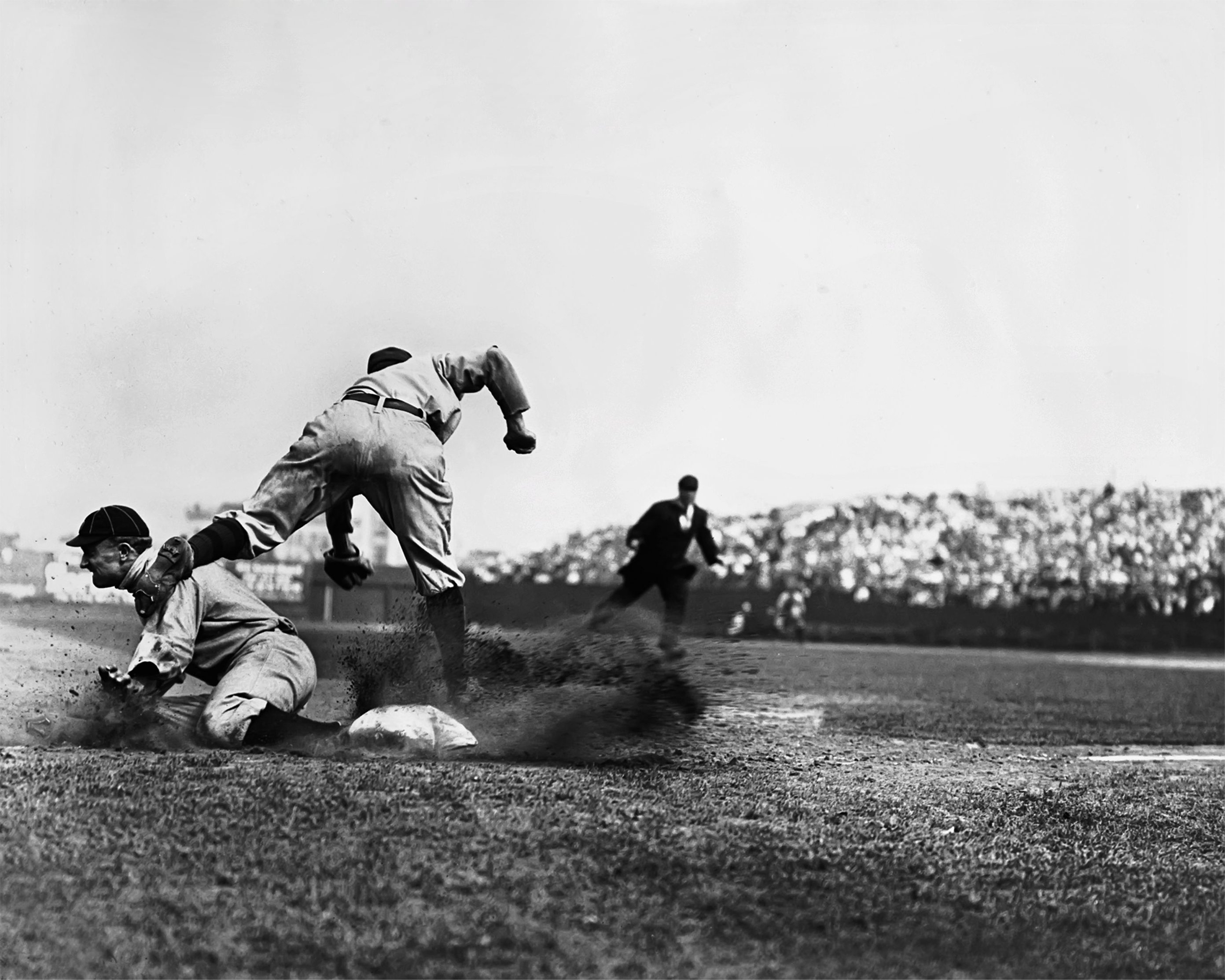
Most likely the first great baseball action photograph ever.
Charles Conlon was a proofreader in New York, but its his photography that made him famous. Over the course of several decades, he photographed the game from the field, something that isn't allowed today.
A photographer is seen on the other side of Babe Ruth, just a few feet away. (Not a Conlon photo.)
While several of the photographs you see see of his are of stars, he also shot portraits of many of the lesser-known players. In all, around 8400 glass plate images survive today, despite Conlon's own efforts at reducing the clutter of his collection by destroying several hundred.
His photography has been published for over a century now, but the first set devoted solely to his work wasn't released until 1981. The Sporting News released a 100 card set that year, and several other sets over the next decade followed. In 1991, the series was rebooted with a new 330 card set featuring his photography. Most of the cards feature portrait photography on the front, as you see above, while the backs generally contain career statistics and a short biography. Several of the cards in the first issue were attached to subsets, such as MVPs, Hall of Famers, trivia, and 1927 Yankees.
The set was a big hit, and would see four more series released, totaling 1430 cards over five years. Some of the cards would be issued in 8x10 versions or as parallels with coloring or other enhancements. The 1994 release had a full parallel set with burgandy borders. 1995 had an insert set linking Ken Griffey Jr. to stars of the past. More subsets would be included, highlighting players' first cards, no-hitters, nicknames, triple crown winners, spitballers, 1919 White Sox, brothers, action photos, and overcoming difficulties.
The original 1991 set is very easy to find, issued in wax packs and complete sets. The 1992-1994 series are also fairly easy to find, though the 1994 series was printed in far less quantity. The real challenge comes in obtaining the 1995 set. I've managed to find a few of the Griffey Jr. inserts but I have not yet come across a base set at an affordable price. It stands out from the rest of the series with gold foil stamping and dark green borders instead of black.

This set is cool because it provides cards for several players who either never received a card or whose cards at the time were unattainable. It also showcases an outstanding collection from one photographer who was a pioneer in his field. I built several of the series by hand, but a set-lot purchase last year provided me with several extras that were extremely useful in building my awards collection, because the set is a great collection of stars from the early stages of major league baseball. Several of the cards, especially the subsets, provide a wealth of history for collectors to learn, and almost every image shows early uniforms, equipment, and ballfields.

The design was just right for its time - a simple black and white design for the black and white photos, with plenty of information in the statistics and write-ups on the back.

It's been over 15 years since the last Conlon release. Should an affordable new release be announced, I would be one of the first to chase a set. It's just that cool.

Sunday, September 18, 2011

Coolness on Cardboard: What should Panini bring back?

This is part two of a six-part series on Panini's Return to Baseball. Part one is here.

It's odd what history Panini has chosen to resurrect in the past few years with the Donruss/Score/Playoff names. I always get the feeling with Playoff that their goal is to create designs with as many straight lines and corners as possible. Is this supposed to copy the rigidity of the football field? Remember, Playoff primarily issued football cards until 2001. Many of the Panini designs seem to have the Playoff feel, which looks great when you're showing pictures of men covered in 50 pounds of plastic and foam, but not when you're showing guys playing on grass.

Donruss has a good bit of history, though, and Playoff had some highlights in the five years they produced licensed baseball cards. Here are some of the cards I like. I would love to see the concepts resurrected at some point!
 Elite Series Inserts: This insert set was *the* toughest pull in 1991, unless you were trying to pull one of those Hank Aaron autographs I talked about earlier today. Each card was numbered to 10,000 - a large number today but tiny by 1991 standards. Even today, it's very difficult to pick these up. I am trying for a master run, but I know that's one of those goals I'll probably never meet. The inserts were always special - the early '90s had awesome foil designs (see the 1992 example above) while later issues had classy designs. On the other hand, the Elite set wasn't as attractive. Sure, it was limited, and sure, it had foil, but it just wasn't The Elite Series.
 Team Pinnacle: The first few years of this set's inception had the best player at each position for each league (one player on each side) on a simple design with high quality art. As much as I dislike multi-player cards, and multi-fronted cards, this set just looks too nice. Later issues just had fancy or foil-based designs with photographs, which isn't the same. The art made this set what it was. The fact that they were tough pulls in 1992 didin't matter. Nope. Not at all.
 Slideshow: Panini can't use the Leaf name anymore, but that doesn't mean it can't make Slideshow cards. Leaf went through several different designs, but they all featured semi-transparent acetate images.
 Score All-Stars and other subsets from the early 1990s: Score experimented. They made all kinds of subset cards for their base sets. Some of the cards in one set were pictures of memorabilia from the Hall of Fame. There were black-and-white images of the best players from each team, and these cartoonish All Star cards inserted in the middle of the set. The gigantic heads on the players only made this set more interesting. Note the artist signature on this card and the Team Pinnacle card above - the same artist appears to have done both issues (or at least both cards).
 Heritage Series: This annual insert from Studio put players in throwback uniforms. Granted, with no MLB Properties license, they can't use MLB uniforms, but I wonder if they could get the superstars back into their high school uniforms, early logoless or vintage-inspired uniforms, or even some uniforms with logos that are no longer trademarked, such as defunct leagues. Could they work something with the Negro Leagues? How about the old blue-collar leagues?
 Dream Team: This should probably be grouped with the Score subset cards above, but what guy doesn't like pulling a card of Rickey Henderson wearing nothing but his underpants and gold chain? Naked men aside, the use of interesting, player-specific studio images made this a successful release.
 Score team checklists: 1994 Score used photographs of stadiums for their team checklists. It wasn't the first, and it hasn't been the last. 2010 Upper Deck used photos from outside the stadium, which was unique.
 Summit Ballparks: Instead of sticking team checklists on the back, Summit cropped a photo of a player and pasted it over a photo of his home ballpark. (Hey, that's a beer advertisement in the upper right corner!) This is just another idea of ways to get photos of ballparks into cards (depending on legality).
 Studio Editor's Choice: Like the Leaf Slideshow cards above, these cards are best viewed when backlit.
 Christie Brinkley Collection: This set continues to interest me 15 years after its release. I like the idea of giving a photographer (or celebrity) the ability to create unique shots. Upper Deck had a similar release a few years prior to this set's issue featuring photography by Walter Iooss.
 Essence of the Game: I like this card because it's a nice combination of foil, clear plastic, and high-quality photography. It's not gaudy, but it stands out.
 Stained Glass Stars: Topps released an insert set similar to this called Gallery of Heroes for a few years as an insert to its Gallery issue. It's another example of a good use of acetate to make a trading card.
 Pinnacle Mint: This set wasn't very successful in its time, but these days Topps is sticking coins in several of its cards. It's a unique release, though, and one of the several experiments that Pinnacle attempted in the late '90s.
 Playoff Portraits: This set was issued only in 2003, but it's a quality art set that is attractive without being a throwback design. I bet Playoff decided that issuing the Diamond Kings art set was enough in that area.
Fans of the Game: This line has carried over from baseball to the three other sports Playoff and now Panini have licenses for. I'm sure it will return. It's a simple concept - celebrities who have a favorite team, plus an autograph version. I'm waiting for an Alyssa Milano card, but I'll have to fight all the other Alyssa Milano fans, Dodger fans, and set builders. Why hasn't Elisha Cuthbert been featured on a hockey card set yet? She dates hockey guys all the time.
 Leaf Exhibits and Sportscasters/Throwback Threads Polo Grounds: Playoff took the idea of variations to the extreme in 2004 when it issued these sets. The Exhibits set contains forty-four variations copying the variations found in the Exhibits cards issued during the first half of the 20th century, namely the printing found on the front of the card. The cards were all serial numbered to low numbers A retail "Second Edition" release was printed in blue instead of black, and wasn't serial numbered. This makes 88 variations in all. 2005's Sportscasters insert had a whopping 140 variations (changing the color of the upper border and two of the icons in the upper right), again numbered to 70 or less. There were nearly three times as many variations a actual cards - the set had 50 subjects. Polo Grounds was also issued in 2005, but had "only" 45 variations, based on the printing around the photo. While the variation idea was taken way beyond what most collectors could fathom (what player collector wants 140 versions of the same card with only small changes in icons and border color?), the issues could have been done a bit differently. I don't recall Playoff ever issuing a real throwback release, other than Donruss Originals, and Sportscasters and Exhibits would have been good throwback sets. The different border colors could be different parallels in a Sportscaster release (leave out the small icon variations) and Exhibits could be issued over several years with the different variations.


 Last, probably my favorite set of all time, Diamond Kings. Done right, the cards look great - be it on 1988-1991's mass produced junk wax, 1994's vibrant designs, or 2002's first full release (below). Diamond Kings went bad in 2005 when the set did the "Playoff" thing and shrunk the image to about an inch in diameter to make room in the massive bottom border for relics and autographs and room to put a frame around the cards to increase the number of limited parallels.
I don't think most collectors hate inserts. I believe collectors want to see something "new" in their inserts. People went batty over the Gypsy Queen framed parallels - they looked good but had been done before (2005 Diamond Kings comes to mind). If Panini wants to stand out in baseball, they can take clues from some of these prior inserts and sets. Notice something similar about every one except Fans of the Game? The cards were designed and executed around a concept other than "leave room for autographs and relics." Most of these ideas can be used without an MLB license. Art cards can easily be commissioned without team logos. Fans of the Game can be done without mentioning the team. Interesting photography can be done without logos. I'm not saying hang out at the gym and catch Pablo Sandoval trying to walk on a treadmill, but this photo on a card would be in my collection as fast as I could bid on it:
Heather Mitts working out. No real logos, and it's a somewhat interesting photo.

Here's an idea completely off the top of my head. Instead of 150 cards showing players standing in front of a studio wall during spring training, arrange to photograph the players in the offseason to see what they do when they're not at the ballpark. Are any of them working a second job? They don't really need to anymore, but you never know. What are their hobbies? Do they do charity work? Do they stay in shape by doing something unique during the offseason? Do they have a nickname other than X-Rod? Where did it come from? Can you create a photo shoot around some of their traits (look at the Rickey Henderson card above)?

Remember, Panini: Your goal is to show collectors and MLBP that you are bringing something special back to the hobby. Part of that is bringing attractive designs - especially with inserts that mean something. The inserts (and sets) above mean something or provide something worth collecting.

None of this:
Shame on you, Playoff. Shame. On. You.


Panini's Return to Baseball:
  1. Panini Swings the Bat
  2. Coolness on Cardboard
  3. The Good
  4. The Bad
  5. The Ugly
  6. BBA: My Own Set

Saturday, September 17, 2011

A TCIC Feature: Looking back at 1992 Fleer Rookie Sensations

As I mentioned a week or two ago, I found 19 of the 20 cards in the super-popular Rookie Sensations insert set from 1992 Fleer. It's one of my favorite sets, not because of the subjects, but because of the beautiful, classy design. 

But how did these sensational rookies do in the end? Let's find out!
 Todd Van Poppel was the A's #1 draft pick in 1990. According to his Wikipedia page, the Braves passed on Van Poppel for Chipper Jones (good move in hindsight, if you ask me). He was fast-tracked to the majors, making his debut in 1991, but was never really successful. Somehow, he lasted in the majors through the 2004 season, though his career record was only 40-52 with a 5.58 ERA.
 Orlando Merced was probably on this list because he was 4th in voting for the NL Rookie of the Year award. He was, at best, an average player, but it was good enough to keep him in the majors for 14 years.
 Jeff Bagwell won the Rookie of the Year award in 1991 and might be the most successful player in the set. He won three Silver Sluggers and a Gold Glove, was a four-time All-Star, the NL MVP of 1994, and his number was retired by the Astros. Bagwell was actually drafted by the Red Sox, but traded away in 1990 for Larry Andersen.
 Jeff Fassero had a few decent years with the Expos and Mariners, but he was 29 in 1992, his second year of major league experience. He faded away as a starting pitcher and wasn't too successful in relief, and finally retired after the 2006 season. He's now a minor league pitching coach.
 Darren Lewis was a career .250 hitter, but is better known for his streak of errorless games, at 392 (938 chances). He retired in 2002, and is now an assistant baseball coach at a San Francisco-area high school.
 Milt Cuyler was a largely unsuccessful second-round draft pick. His debut was in 1990 and somehow he lasted through the 1998 season. He's now a hitting coach in the Gulf Coast League.
 Brian McRae was drafted in the first round in 1985, and had his debut in 1990. His father managed the Royals in 1991 and he was fairly successful through the 1996 season. After a quality 1998, he slumped big time, and ended his career at the end of the 1999 season.
 Mike Timlin got his start in 1991 with the Jays and was the pitcher who recorded the final out in the 1992 World Series. He pitched in over 1000 games, and was very successful in relief during postseason play. He played in his last major league game in 2008 and retired in 2009.
 Chuck Knoblauch was the AL Rookie of the Year in 1991 as a member of the World Series-winning Twins. His best years came with the Twins through 1997, though he was a big part of the Yankees World Series championships in 1998 and 1999. He developed throwing problems in 1999 that he would never recover from, and retired in 2003.
 Rich DeLucia was less than stellar in his rookie 1991 season - he had a 5.09 ERA and gave up a league-leading 31 home runs. By the middle of 1992 he was a middle relief pitcher, and he compiled a 4.62 ERA in 10 seasons. His inclusion in the set is puzzling at best.
 Ivan Rodriguez is still playing - the only one left from this set. He's most known for his fielding, winning a record 13 Gold Gloves, though he's an excellent batter, with a career .297 average, more than 300 home runs, and seven Silver Sluggers. He's currently training his eventual replacement with the Nationals as he platoons behind the plate.
 Juan Guzman made his debut in 1991 and had three good seasons, but struggled in 1994 and 1995. He made a great comeback in 1996, leading the league with a 2.93 ERA, but future seasons would not be as successful. He retired after 10 seasons with a 4.08 ERA.
 Mark Wohlers eventually became the Braves closer, being part of a 1991 three-pitcher combined no-hitter on the way. He was one of the best closers of the mid-90s, but after giving up a home run in the 1996 World Series, Wohlers would never be the same. He struggled through the 2002 season before finally retiring.
 Steve Chitren is the second Athletic in the set, and was born in Tokyo. Chitren may be the least-successful player of the bunch. He had a good start in 1990, with an ERA around 1 in nearly 18 innings, but posted a 4.33 ERA in 60 innings in 1991 and never took the field in the majors again.
 Wes Chamberlain was probably in the set because of his fifth place finish in the 1991 Rookie of the Year voting. 1991 would be his best year, however, and he would leave the majors in 1995. He played in Japan in 1996 and would play for some independent league teams through at least 2003.
 Ray Lankford was successful for Cardinals through 12 years, and despite an average batting average and large number of strikeouts, he had a high on-base percentage and good power and speed. I remember talks of him being the next Rickey Henderson, though that never materialized.
 Phil Plantier had an excellent rookie season in 1991, and if he had put up those numbers for a full season he would have walked away with the Rookie of the Year award. While 1993 was a good year statistically, he never put up the kinds of numbers seen in 1991 and played his last game in 1997. His 91 career home runs are a record for players born in New Hampshire (who finds this stuff? It's on his Wikipedia page). He was promoted to manager of the Lake Elsinore Storm this season.
 Chito Martinez was the first Belize-born major leaguer, and put up impressive numbers in 1991. However, he peaked early, and was gone after appearing in only 8 games in 1993.
The last player for whom I have a card, Scott Lieus, hit the game-winning home run in the second game of the 1991 World Series, which might be why he received a card in this set. He had a successful first full season that year, batting .286, and was a quality fielder at third base. He managed to find his way into a couple dozen games a year in the late 1990s, but his career was essentially over after the 1995 season. His last game was in 1999.

The only player I'm still missing from the set is Frank Thomas, one of the three big players included in the checklist. After successful 1990 and 1991 seasons, there was no doubt as to why the Big Hurt was put as card number one in this insert. He is the only player to compile a career average over .300, as he hit 521 home runs over 19 seasons. He was a superstar through 2000, but still put up respectable numbers through the end of his career. He's the only other player in the set with a retired number (with the White Sox), though that could change when Rodriguez retires. He was a five-time all-star, four-time Silver Slugger, two-time AL MVP, 1995 Home Run Derby champion, and 2000 AL Comeback Player of the Year.

Looking at the list, only a couple players didn't make it beyond their third year, and while only three became HOF-potential superstars, several of the "Rookie Sensations" were productive for a decade or more. Why is that? I believe part of it is because all of the players had experience, with most of them making their debut in 1990. As such, they all showed promise after receiving major league experience. These days, most insert sets focusing on hottest rookies include mostly minor leaguers (such as the Bowman's Best Prospects insert set). There's no guarantee Bryce Harper will be successful in the majors or even make it at all. Another part may be research done by Fleer in deciding who to put in the set. Only a couple players were fast-tracked, and thus had time to develop and mature.

Will we ever see a set of this size with so many successful rookies again? It's possible, but not likely. The 2011 Gypsy Queen Future Stars set might be this year's comparison.

What are your thoughts?