Chaos and Kanji is the blog where I write about my adventures through Japan!

Want Lists are located here. NPB Baseball Want List is located here.
Showing posts with label commentary. Show all posts

Tuesday, April 21, 2020

My Turn: Things You Like, But I Don't

Okay, so yesterday I wrote about things I like but many people don't when it comes to collecting. I guess I should flip it and tell you about the original idea. And since yesterday's post was inspired by Fuji, here's his post on the original idea.

Here are some parts of collecting cards that most people like, but I don't.
Graded cards. The cases are bulky. I only have a few graded cards, so they don't file away nicely. Grading is expensive and there are several scandals related to the industry. I don't reject graded cards, but I won't pay a premium for a high grade, and I'll choose a non-graded card over a graded card at the same price in many circumstances.
Prospecting/investing. I've been around long enough to know that most rookies just don't pan out. That's just how it works; if every player was a superstar, nobody would be a superstar. But it takes a lot of study to successfully invest, not to mention money and the inherent risk. I have better things to do.
Busting packs and boxes. Okay, I like the thrill of the chase. But it rarely pays off in the end. When I was a kid, a 50-cent pack of Topps meant at least 50 cents in value. A $2 pack of Topps today doesn't have $2 in value; there are fewer cards that are still usually worth only a dime each. And then you have mid-tier sets like Gypsy Queen, which ups the cost per card with only a slightly-larger chance of getting a big hit. If I was making twice the money I am now, I might open some boxes, but for now, I'll stick with lower-priced methods.
Online products. Yesterday, I mentioned that I like online singles resources, like COMC and Sportlots. But Topps has been issuing a lot of online cards that cost a lot more than they should, if you ask me. A typical card with a print run of 500-1000 might sell for a dollar or two, but online exclusives tend to run double, triple, or more. In fact, online singles (Project 2020, for instance) cost $10 each, despite very high print runs. I love a lot of the designs, but they are extremely overpriced.
Building big sets. Like Fuji, I find it much easier to just go on eBay and pick up a full base set and some insert sets. There are other sets that require putting together one by one, but with so much else on my collecting plate, it's not like I'm not being challenged as it is.
Box breaks online. If I was getting cards out of the deal, that'd be great. And if I'm at a shop, I enjoy watching other customers open packs. But box break videos are boring. There's no amount of overacting you can do to make it more fun for me. Maybe if someone like Emma Watson was opening the packs? Maybe not even in that case.
Parallels. In the 1990s, there were sets with one or two parallels. Now, we talk about collecting rainbows. It has really gotten out of hand. Panini in general is very bad about this. Topps has their fair share, though; inserts have parallels, plus relic parallels, autograph parallels, and autograph relic parallels, and then all the variations. There are just way too many sets out there. Mike Trout had over 2500 cards issued last year according to Beckett's database. A little over 150 were from main sets, and over 1700 were parallels or parallel inserts (the remaining 650 are inserts). 
Attitude. These days, the field is full of bat-tossing, helmet slamming jerks. I see tons of clips of players arguing with umpires, fighting, and trash-talking. It's a product of today's society, I know. Baseball isn't hockey, though. Whatever happened to tact? (You know you're getting old when you start a sentence with "Whatever happened to...".)

Look, you probably like some of these things. Or all of them. I'm cool with that. But don't expect to convince me to change my mind.

Monday, April 20, 2020

My Turn: Things I Like, But You Don't

Last week, Fuji put a twist on the "Things you like, but I don't" concept, by literally twisting the I and you. So, let's rip that idea off, shall we? At least, I will.. you do what you want.
Oddball cards. In the 1980s, there weren't many insert cards, and as a kid I certainly couldn't buy enough packs to put together full sets. So the chase for me was looking for cards in odd places. I scoured the candy aisles and checkout counters for packs, scanned junk food and cereal boxes for cards, and searched through the toy section for those little box sets.
Foreign cards. These are pretty oddball, too, but there are a lot more people interested in Bazooka cards than CPBL. They are the ultimate oddball, I suppose. Unique designs and ideas (Japanese game cards, for example) and a different sort of game on the field.
Cheap cards. I have some nice cards in my collection, but many of my collecting interests can be satisfied with cheaper cards. So while everyone on Twitter and Reddit are showing off their big buck autographs, I'm happy here with my base cards.
Lower condition. As a budget collector in many cases, I'm happy to take softer corners or even creases to save some money or finish off a set.
1989 Topps. A giant script name with a color border. A very simple, almost boring design. Very few action shots. It's not a great set, and perhaps just a tiny step up from 1988. But it is the first set I remember collecting, so it has a sentimental place in my heart.
Non-Sport cards. Movies, television shows, and music are a big part of my life, so collecting entertainment cardboard makes a lot of sense.
Themes. I love finding themes to collect around; I have several low-fuss player collections but I like to look for other collections to make.
Online singles shopping. People love to complain about sites like eBay, Sportlots, and COMC, but living in Japan, I have no other choice. I've learned which site is best for my interests and budget for particular purchases, and with no reliable card show or shop to pick up US singles from, I've had to rely on them. I miss dime boxes, but I can get some decent values online.
Price guides. They are nothing but a guide, but used properly, they can be very helpful. They serve as good checklists and research tools; I love my old SCM guide and the Japanese card guides I have. And they also serve their purpose as a guide for card prices; card values change, and Beckett isn't the bible of card value, but it is a decent reference if you know how to use it.

Fuji says people are people. I say:
I agree with Fuji, though. When you collect what you're interested in, it's more fun. If it's not fun, it's not a hobby. It's a chore.

Until next time...

Sunday, February 16, 2020

Inspired: The Immortal 10,000

Sean over at Getting Back into Baseball Cards... in Japan recently discussed his thoughts on the ideal card collection size. As he mentions, Japan is a small country, with small houses. His thought connects to a Persian army unit known as the Immortals: a group of 10,000 soldiers which was supposedly Persia's best. Any time a soldier left the army due to death, injury, or illness, he was replaced immediately from another unit, maintaining that unit's strength. And, apparently, the unit was comprised of Persia's 10,000 best soldiers.

So, Sean figured that for him, a collection of 10,000 cards might be the ideal target. Big enough not to cramp his style, but manageable enough to fit in a small space - he says two monster boxes, though I'm sure with sleeves and given the thickness of some older cards, it might be three 3200-count monster boxes, or even three 5000-count boxes.

But what if I had my own Immortal 10,000 cards - across all of my collections, across an ocean and a continent?
My player collections come to a bit over 1000 cards. The majority is actually just Jose Altuve, followed by Buck Farmer, Charlie Hough, and Bobby Cox. The other players are very minimal collections.

Add another 1000 cards for my random singles. Many are from outside baseball or even sports in general. That includes some regular base or insert singles along with my autograph and relic cards.
Next would be Japanese singles, which when push comes to shove would probably be about 1000. And 1000 more cards for my two player collections (actually just over 600 now, but that gives me room to grow). Plus another 1000 cards for some specific Japanese sets I'm pretty sure I'd want to keep.

There's still another 5000 cards to go. The only thing I would probably keep to fill that up is the awards collection I put together. That is a lot of cards, and I might not be able to keep both the Japanese and US collections.

Honestly, keeping the awards collection just to have 10,000 cards might be a silly idea; I'd probably just go with everything else above and expand on some of those as I see fit.
So, what would I be giving up? My type collections (the hardest things to let go, but both are quite large), a couple very large singles collections, and almost all of my sets. I would be getting rid of many, many more cards than I'd end up keeping.

The funny thing is this: cards do take up space, but that's not my biggest (literally) problem. I have many other souvenirs from my travels and knickknacks for baseball and entertainment. If I needed space, those would probably be the first things I'd work through. In fact, I did that a couple years ago, and I'm planning to do it again this spring!

Until next time...

Thursday, January 30, 2020

1 Not 1/1 1/1

I've been busy! I finished my road assignment last week, and got back home on Sunday... and promptly went out to a card show and a couple card shops. I still have three piles of things to put away in different places, and three stacks of cards from the show and recent online pickups. I've been using my free time to get reorganized and settled in, inventory and scan everything I've picked up, and properly cook dinner. And yesterday, I worked across town - about a 90-minute commute each way. But now I'm working nearby, so I should have more free time. Let's get back to writing, huh?

When is a 1/1 not a 1/1?

The first, easiest argument is aftermarket 1/1s. I'm sure there's still a bunch of those out there on eBay and circulating at shows and in shops. Some guy prints up some 1/1-notated hologram stickers or comes across a foil stamper, creating their own "special" 1/1s. I'm not sure I could call them fraudulent, unless they're misrepresented in some way.

But that leads to fraudulent 1/1s - cards made to look factory-stamped as 1/1s, copying the position, style, etc of legitimate 1/1s. Some aftermarket 1/1s would fall here, as I think hiding some small print in your eBay listing is deceptive.

And since I mentioned eBay in the first two examples, the third eBay example is "eBay 1/1s" - #1/25 is not a 1/1. Jersey number-serialed cards aren't 1/1s. So on, so forth. It is highly possible that, for on-card autographs, the first serial-numbered card was the first or last card signed by the player, meaning it could have the best (or worst) signature. But that's different.

I still consider factory-stamped "event" 1/1s to be 1/1s, but with asterisks. When Topps, Donruss, Upper Deck, etc. made 1/1 cards for Nationals or other card shows, the only distinction was the 1/1 stamp, and thus aren't really any more unique than the regular base cards that they parallel.

Along those lines, any 1/1 parallel that isn't unique from its base card beyond the stamp is somewhat depressing. Parallels, overall, need to be distinctive. Topps Triple Threads has some relic sets that are impossible to distinguish from each other beyond the serial numbering, for example.

Printing plates are marketed as 1/1s, and yes, there should be only one black printing plate for Ichiro in 2003 Topps, but the three other colors are essentially the same thing. I'll take all your Buck Farmer printing plates off of your hands, but as far as my type collection goes, eight Topps Total plates (front and back, four colors each) equal one entry in my list.

Now, there are cases of accidental one-of-one markings on cards or entire sets. Those definitely don't count. Sometimes, they're supposed to be one-of-one, but they aren't.

And then there's Topps Moments & Milestones.
In 2008 Moments & Milestones, Alex Rodriguez's milestone is his 518 home runs hit through 2007. Base cards are numbered to 150 - a low number for a base card. But each home run has its own "mirror" card - the large number at the bottom of the card. So 150 x 518 = 77,700 cards for A-Rod.

The same thing happens with parallels. Each black parallel is numbered to 25; that makes 12,950 A-Rod card #1s numbered to 25. Blue? #10, so 5180 cards. A card numbered to 5000 in 2008 would be in the fifty-cent bin, but numbered to 10 adds an artificial premium.

And that means the red 1/1 cards are very rarely 1/1. In fact, only Dice-K and Ichiro have true 1/1 cards in the set. There are 518 A-Rod card #1 1/1s... again, a card actually numbered to 500 in 2008 was maybe a $1-2 card at a show.

The Albert Pujols card above is the second 1/1 card I've found from this set. I don't have two Pujols 1/1 cards from this set, I think. But there are 195 of them in all!

Is this card a legitimate 1/1? Okay, yeah. It's the only card from 2008 Moments & Milestones which features Pujols' 126th hit of the 2005 season. But there are 194 other cards which highlight his hits in the 2005 season, so it's less special to me.

That said, since I already have a red parallel from this set, I can put a 1/1 card in my Albert Pujols collection!

What do you think? Is this really a 1/1? What do you think of the other 1/1 flavors?

Until next time...

Saturday, March 25, 2017

Card Collecting: The Worst

Big Chips... eh, Nachos Grande recently asked the question: What's the worst part about card collecting? This isn't really a blog bat around (that comes tomorrow), but I figured I should chip in my two cents.

First, El Grande listed off a few things that could be pet peeves, so let's address those.

2001 Topps Heritage - [Base] #405 - Mike Piazza - Courtesy of COMC.com
Short prints. I am a multi-faceted collector, with sets being one of those. Short prints can be very irritating, depending on their rarity and complication. Really, when push comes to shove, aren't all inserts and hits short prints? What once were subsets nestled within the regular base set are now shiny rarities printed in limited quantities. I guess since they generally are numbered separately from the base set most people forget those. Anyway, I ignore short prints in many sets; some of my complete sets have them, while others don't.

2012 Topps - [Base] #93.2 - Skip Schumaker (Rally Squirrel) - Courtesy of COMC.com
Gimmicks. I love gimmicks. But like short prints, they can't be impossible to obtain. A card of a squirrel? Okay, but I am not paying $100 for it. Variations? Okay, but I'm not paying $100 for them. If they're part of the base set, I can ignore them completely, since they don't fit in my type collection.

1989 Fleer - [Base] #616.1 - Bill Ripken (FF on Bat Knob) - Courtesy of COMC.com
Error cards. If they aren't real, don't they become gimmicks? Real error cards can be fun just for the novelty, but not the scarcity. I have one of the 1990 Donruss reverse negative errors and the "Rick Face" error card as well. Sometimes, I might chase errors or variations for a complete set, but I can pick and choose.

2002 Topps Total - [Base] #2 - Derek Jeter - Courtesy of COMC.com
Big and small sets. I love big base sets. I want sets with all of the players. Not every set needs 900 cards, but it is nice to have definitive records on cardboard. Topps Total was a wonderful thing, though since it didn't have a huge profit margin Topps dumped the concept after a short while. As for the smaller sets, I'm happy with the 400ish-card sets like Gypsy Queen and Allen & Ginter, and even the 100-200-card sets like Donruss and Goodwin Champions. Depending on the concept and the goal, any set size is okay.

1992 Topps - [Base] - Gold #1 - Nolan Ryan - Courtesy of COMC.com
Parallels. Okay, this one can be irritating. Much of Playoff's and Panini's products from this century have been overdone with parallels. At least one of Panini's sets has parallels, parallels of the parallels, inserts, parallels of those inserts, and variations of those inserts (number of players, relics, number of relics, autographs, etc) with parallels of their own. But other than my type collection, I can take them or leave them.

1989 Fleer - Team Stickers Inserts #ATL - Atlanta Braves - Courtesy of COMC.com
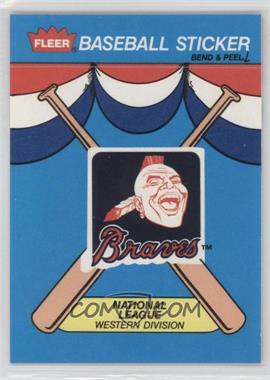
No more "premiums" in the packs. I do miss getting packs with team logo stickers (Fleer, Upper Deck), puzzles (Donruss), and... okay I can pass on the gum. Hey, why doesn't Donruss, which is a retro-based brand, have puzzles? Anyway, these kiddie things were fun, but have now been replaced with the inserts. What I really miss, however, are cards inserted in with food. I doubt we'll ever see tobacco with trading cards again, but I miss cards in cereal and candy. There has been some promise in this area, since cards showed up in pizza in the US last year, and with sausage here in Japan!

9-pocket pages. Yes, having too many types can make the OCD in me go off, but I managed. I generally stuck with the same type per binder, and along those lines, I generally got the same type most of the time.

No, those could be good or bad. But what really bothers me?

2008 BBM Tohoku Rakuten Golden Eagles - Shining Star #ES1 - Masahiro Tanaka - Courtesy of COMC.com
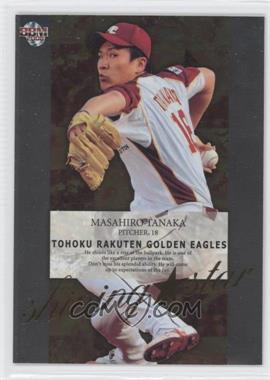
Well, I was going to go with meaningless insert sets. But it seems like Topps has been doing better with that; this year's flagship inserts generally have some sort of focus. In Japan, though, inserts are just shiny images of players on colored background with a remotely clever title related to the team's location, name, colors, or mascot. Each set here seems to have a set of 9 or 18 inserts just because they have to. But that isn't the worst.

No, it's the continuing movement toward a higher percentage of "hits" sets in each release.

My 2016 type collection list isn't 100% complete, but for the 43 base sets I do have recorded as being released, there were 273 parallel sets, 167 insert sets, 240 parallel sets for those inserts, 350 sets with hits (autographs, relics, manu-relics), and 1080 parallel sets for those hits. Plus an additional 25 oddball sets. So for the 2178 card sets I have recorded for 2016 so far, more than 50% are hit parallels. 2015 is only slightly better.

2015 Panini Immaculate Collection - [Base] - Blue #142 - Rookie Autos Blue - Buck Farmer /49 - Courtesy of COMC.com
The explosion started around around 2011, the year Panini returned to MLB cards. There's been a steady increase in the number of parallel hit sets, and in 2013 there was a massive four-fold increase in insert parallel sets as well. My type collection includes every single set ever made.

2016 Panini Donruss Optic - Rated Rookies Retro Signatures - 1984 Gold #84-MS - Miguel Sano /5 - Courtesy of COMC.com
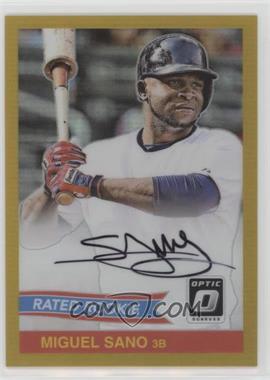
So not only do I need a 2016 Donruss Optic Rated Rookies 1984 Retro Signatures card, but I also need the aqua, black, blue, Carolina blue, gold, gold vinyl, green, hologram, orange, and red parallels. That's 10 parallels for one set. Repeat for 1985, 1986, 1987, and 1989. So Donruss Optic's five Rated Rookies Retro Signatures sets have 50 parallels between them.

Just as a comparison, 2016 Stadium Club, which is a similarly-priced brand (at least, MSRP), has a total of 33 sets. Total. With five autograph sets and six parallel hit sets.

2014 Panini Golden Age - [Base] #SP-84 - Jacqueline Kennedy - Courtesy of COMC.com
I guess I could say Panini is the worst part about card collecting, but that's not fair. I like getting the Donruss flagship set and Diamond Kings every year. There have been some intriguing releases in the past (Cooperstown and Golden Age, for example).

2016 Panini Prime Cuts - Timeline Quads - Gold #TQ-RM - Roger Maris /5 - Courtesy of COMC.com
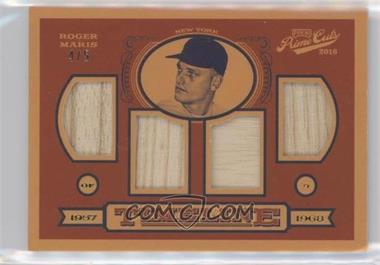
Unfortunately, since Panini apparently only really focuses on the high-end collector (Flawless, Immaculate, Pantheon, Prime Cuts), there's not much left for me to get behind. And with complicated releases with dozens of parallel hits, my type collection might need some rethinking. And that's what really bothers me. Don't get me wrong, Prime Cuts looks beautiful. But I can't afford to fill my collection with 1000 cards like this every year.

As an everyday collector, it's easy to ignore all of these parallels. Even as a player collector, I do that. For Jose Altuve, I just chase after his base and insert cards, and keep parallels whenever they fall into my lap. But the completist type collector wants these cards.

Thursday, September 24, 2015

Player Collecting: My Thoughts

I've already talked about my player collections at various points in this blog's career. But a recent post by the Lost Collector, referencing an article by Sports Collectors Daily that I too had read, got me thinking about how my "PCs" have developed.
Of course, by PC, I mean player collection. Yes, I have a "personal" collection too, but the details of that are best saved for another post.
I've tried briefly to be a "super-collector" like TLC for Tony Gwynn and Nolan Ryan, and Hackenbush mentions that his attitude is the best (and possibly only) approach. It's certainly true that owning all of a player's cards is virtually impossible now - the one-of-one cards alone mean some singles may never see the light of day via auction or otherwise. But you don't even have to get everything you can.
Knowing that, I do have three "super" PCs. Geoff Geary was the first, later followed by Charlie Hough and Buck Farmer. I have my reasons for each of those three, but they are super collections for personal reasons, not really on-field performance reasons. I'd like to have all of their cards, but I know it's just not possible. For Buck, I have split his cards into "should have" versus "like to have" based on the print runs. I'm very happy to say I have several one-of-ones but someone else out there is sporadically grabbing them too, at big prices.
It is possible to have "all" of a player's cards, if you define "all" in a reasonable sense. What that means will be determined by your wallet and interest. I collect Jose Altuve like this - for me, "all" of his cards are the base and inserts. If I get parallels, I add them to my collection, but I don't hunt for them like the other singles. I'd like to add an autograph and relic cards at some point, too.
I have a third tier of player collecting and it's the easiest. Following the "traditional" approach that one probably would have had in the 1960s or 70s, I just get the Topps flagship card for several players each year. There are 22 players in this category, and some of them are retired, so the collections are "complete" to my liking. I've spiced it up a little by adding a bat relic card, jersey relic card, and a figurine or bobblehead to my requirements, but it's a good way to have a small PC collection that can "honor" my favorite players but not break the budget.
I think the key is having a goal that is attainable but challenging. It really isn't hard to get all the flagship cards (unless you collect Mickey Mantle) but player collecting isn't my main focus. Going after non-parallels, or only pink parallels, or something like that can add a bit of a twist.
And while there may be hundreds of cards for a player in one year, it's so much easier to get rare cards than in the past. I've had a lot of luck with eBay for my Buck Farmer collection, but Just Commons, COMC, Sportlots, and even Beckett.com's marketplace have proven themselves to be good sources of singles. The internet is an amazing thing, and there are plenty of message boards and the blogs themselves to complete trading.

Friday, January 2, 2015

2015: Finishing What I Started

There are a lot of projects and collections "in progress" right now. I am going to try to complete as many of those as possible this year.
Here are my collecting goals for 2015:

  1. Get six flagship sets that I need. This could be pretty easy - 2014 and 2015 Topps plus the two Update sets and Stadium Club sets would be a quick six. I would like to tackle some of the other sets I need, though.
  2. Locate the eight cards I need to finish the card portion of player collections for six players. Not a difficult accomplishment, but important. Additionally, keep up-to-date with 2015's releases for my player collections.
  3. Find at least five of the ten figurines I need for my player collections. 
  4. Get down to 400 needed cards for my Awards collection. I cut the list in half, to 494, over 2014, but the remaining cards will be a bit more of a challenge.
  5. Keep my MLB Type Collection over 25%. It's at 25.5% now, but the past three years my collection has seen under-20% performance. (I should add that the number of sets issued each year since 2010 has been steadily increasing and is now more than double what it was that year... if my database is accurate.) I have been working almost exclusively with Just Commons and COMC to get the singles I need.
  6. Reduce my wanted sets list to 175. There are 229 sets in the list now, between Diamond Kings, Team USA sets, and dozens of other issues. I can finish some sets and delete others. 
  7. My Japanese type collection is at about 54%. I'd like to reach 60% by the end of the year. That's about 300 singles besides 2015 releases.
  8. Reach 50% of sets in the Japanese type collection other than BBM and Calbee. Only about 40 singles will get me there, but most of those are old menko and bromide issues that just don't show up often.
  9. Create and hopefully complete a collection for players who went from the NPB to the MLB.
And my blogging goals for 2015:
  1. Finally finish those Calbee Through the Years posts. I've been working on this half-heartedly since 2013. One of the reasons I've been delaying this is that I don't have a 100% complete Calbee type collection. I'm not sure I'll get that far, though, so I'll have to just make concessions.
  2. I want to publish my Japanese set database. I've got a lot of details ready but I'll need to take a weekend or two to really piece it together and make it shine. Recent discussions with a couple other bloggers might make this effort obsolete, though.
  3. Continue posting new release details on all of the 2015 baseball sets.
  4. Fully update my Japanese card shop posts and publish a map and list. Many shops are up-to-date, but I've been to many places that I haven't reported on, or can get additional details.
  5. I didn't really commit to it, but I enjoyed my "Idol of the Week" posts. I'd like to make that a regular feature, and furthermore, start cataloging all of the idol and other non-sport card sets out there.
What do you think about my goals? What are yours? Post here or post a link if you wish!

Tuesday, December 30, 2014

How did I do in 2014? Reflecting on this year's goals.

At the beginning of the year, I set fourteen goals for my collection and the blog. Let's review all of them and summarize my successes (and failures).

1. Reach 65% on my Japanese type collection.
I was at 56% at the beginning of the year, and now I'm at 53%. As far as the list at the beginning of the year goes, I have passed 65%. But a new guide with dozens of new older sets was released, and I also updated my lists from 2008-2013 with better data. I'd consider myself successful in improving my type collection.

1b. Find the last fourteen Calbee cards for my type collection.
I now need 46 cards for my Calbee type collection, thanks to the guide and research on some very rare sets. No good. I didn't really get a chance to Calbee hunt, either, so it's not like I made much progress on the first fourteen.

2. Complete the Calbee Through The Years post series.
Well, I didn't get past the 1970s.

2b. If I meet my second goal I'd like to do the same idea for BBM.
Yeah, no.

2c. Finally, I created a framework for a table of contents/index for my set posts, but I'd like to refine it and post it to the blog.
It's not published, because the Calbee posts were pretty much put on the back burner. But I've been building the index page.

3. I want to do better with my new release posts.
I'm not too far behind with this year's posts. I think I missed a couple, but I really posted a lot of details on the new sets as they were released.

3b. I'd like to bring back the previews and reviews of new MLB sets.
I tried this at the beginning of the year, but I quickly tossed it aside. Getting MLB cards in Japan is not easy or cheap, and I just can't get interested in something I can't actually hold. That said, I haven't abandoned my MLB collections, far from it.

4. Do something with Cardboard Zoo.
I haven't touched the site all year. However, my new release posts here for Japanese cards would be something I'd probably post on the Zoo. The spirit stays alive, though the content is now here.

5. Finish my NPB Live Game Collection.
I finally got this collection completed early in the year, and the single NPB game I went to this year was updated pretty quickly!

5b. I'm not really ready to start the MLB version of this collection, but I want to start creating a checklist.
Not only did I create the checklist, I went through the generous stash of cards in my collection from Kenny (Zippy Zappy) and others to knock a sizable percentage of the names off the list! There are 2321 total items on the list, of which I already have 543! Not bad for a random pile of cards mostly issued in 2012.

6. Collect 2014 sets.
I have almost all of the sets I want from this year's releases except for the flagship Topps set and Update, and Stadium Club. I've been trying to find a good deal for each of those, but have been unsuccessful. I need some SSPs from Goodwin Champions, too.


6b. I'll build some insert sets from 2014 too.
Again, I was fairly successful here, though I need:
  • almost all 2014 Donruss Diamond Kings cards I have #29.
  • most of the 1989 Minis from Topps
  • and a few of the 1989 Chrome throwbacks
7. Post more details about Japanese card shops.
I published a few more card shop posts, and I built a few pages to be published in the future. I'd say I was pretty good here, though there is more I can do.

8. Finally, I want to post about the various awards and their winners in NPB.
I didn't get here. My Awards collection is about as complete as it can get, other than the 2014 winners. But I didn't get any posts written.

There were fourteen goals for 2014, of which four were complete failures. Three were partially successful, and two of those could be completed with a bit of cash or time.

That means I was fifty percent for the year. With my ambitious goals I'm not surprised that I couldn't finish them all, but I was hoping to at least get a C grade. There were other major accomplishments that I managed this year, too, though.

  • I reorganized my set inventory spreadsheets, combining all the sub-collections into one big master sheet.
  • I dove head-on into my player collections, and murdered the list!
  • I also added two players to the list and made major gains for both of them.
  • I mentioned this already, but I did some major updating of my Japanese type collection lists.
  • I've scanned all of the cards in my Japanese sets, front and back.
  • I photographed all of my souvenirs and collectibles.
  • I built the 2014 Calbee set by hand. Well, the first series completely by hand, the second series partially, and the third series through a single auction purchase. (I'm still missing three cards that I plan on getting by the end of January.)
I'm happy with the way 2014 turned out in my hobby! What will I aspire for next year?

Saturday, December 13, 2014

More Thoughts on the Oldies Collection

Interestingly, this is post 1111. I just thought that was pretty funny.

The last couple days, I brought information about two fairly simple new box sets, from the Oldies Collection, also titled (subtitled?) Achievement.
I'm guessing and hoping that the Oldies Collection will be a longer, ongoing series that uses multiple designs, while the Achievement set will hopefully maintain the same design, similar to the Legends series. BBM can really use a quality throwback series (other than Classic, which is a set that reuses BBM designs), and I think this might be it.
 The basic design idea for the Achievement series comes from menko cards, especially the tobacco ones with simple designs and moderate text on the front, and of course monochrome backs. (Note that the front and back images above come from different cards.)
There are a lot of great old sets to pay homage to. I suppose the most iconic is Calbee, but that's an ongoing issue which really shouldn't be copied.
 There are somewhat-modern sets like ID Card (above) and the Takara series. Takara would be a good choice.
 Some of the earliest cards are not menko, however, they're bromides. These are even simpler than menko, basically photos with a line or two of text, and usually blank backs. This could be great as an oversized box-topper.
 The basic tobacco menko I showed above is a great start, but I'd love to see a return to the colorful drawings found on 1950s menko sets. I don't think I've ever seen a full art set other than the Players Collection series issued in 2003 without team logos. Additionally, the backs with game characters, random digits or even other subjects (fruits, anyone?) were a nice addition.
  Round and die-cut menko could be great inserts as well.
 While menko cards are generally the most beautiful Japanese cards I've seen, karuta designs and plenty of issues by other manufacturers are also great sources of inspiration.

Actually, a great one-off addition to the Oldies Collection would be a nice 144 card set grabbing a few of these ideas. The base set could have the players on menko designs - perhaps one menko design per team. A parallel could have various menko backs instead of the standard backs, and original-sized menkos are possible one-per-pack parallels here.

Inserts have a lot to pull from. Large-format bromides and oversized die-cut menkos would be awesome box loaders (something BBM has never done, as far as I know), Perhaps one of each per box. A cartoon menko insert set would be great, as would an additional insert set or two using another retro card design.

BBM has never done a Allen & Ginter/Golden Age style throwback set. What do you think about this?