Chaos and Kanji is the blog where I write about my adventures through Japan!

Want Lists are located here. NPB Baseball Want List is located here.

Tuesday, April 28, 2020

Book Review: The Mick

The first autobiography I can remember reading since... college? The full title here is: The Mick: An American Hero, The Legend and the Glory. It's written by Mickey Mantle himself, with Herb Gluck.
I'm not that old. Mickey Mantle is another one of those old Yankees stars that I didn't really know about. I knew he was a switch-hitting power hitter during the Yankees 1950s dynasty. I knew he had bad knees and was a spokesman for Upper Deck in the '90s.

This is the smallest book I've read so far this year. It has 260 pages, but it's smaller, and written in a very casual, simple way.

It's Mickey Mantle, telling his story. As such, there's a good bit about Mantle's life behind the scenes. Mickey talks about his childhood and teenage years in Oklahoma. He talks about his pastimes, schooling, girls, and his family's financial difficulties.

As he moves into his career, he talks a lot about his teammates and life off the field. He mentions his performance on the diamond, but he approaches his accomplishments with a self-deprecating attitude.

He comes across as a good ol' boy, and I'm not sure if that's who he really was or if it was an image created for the book or publicity in general. Mantle talks about partying and hanging out and generally having a fun attitude, and based on what I read in October 1964 I have to believe him. So maybe he really was a fun-loving simple guy who loved to play ball.

I think I finished this entire book in just two days, with about two to three hours of actual reading time. So it's very easy to read. But like the other books I've been reading, it has a good narrative and it's possible that Mickey wrote his own movie; I could see this book turned into a biopic. The only problem - Mickey tells some interesting short stories, but there are fewer scenes than summaries here.
It is a New York Times bestseller, written back in 1985. Thirty-five years later, there isn't much new to add to Mantle's life. Mantle shows he is a product of his time, though; there's a lot here that might not be published in a book today.

Monday, April 27, 2020

Book Review: You Gotta Have Wa

A surprisingly easy read, You Gotta Have Wa by Robert Whiting examines life as a foreign baseball player in Japan.
This book was first written in 1989, and it is still being printed today. That tells you how good it is.

Life in Japan isn't easy for foreigners. We are often considered temporary visitors here to serve a specific role. I'm an English teacher, and as such not considered to be someone who would live here permanently. The Japanese way is considered difficult for foreigners to udnerstand. And it is; likewise, the American way can be difficult for Japanese people to get used to.

Foreign baseball players in Japan also serve a certain role. Many times they are called "suketto", which basically means helper. A player like Cecil Fielder is expected to hit the long ball. While foreigners have taught a thing or two to Japanese players, game strategy and practicing style remained unique to Japan.

Have you seen the 1992 movie Mr. Baseball, starring Tom Selleck? It's almost forgettable, but there is a lot of truth in what you see in the movie. Selleck's character receives uniform #54, because that is how many home runs he is projected to hit. The manager hits one of his players in the head for making a mistake. The team doesn't know how to have fun; baseball is war. Some players know a little English, but improperly use it or only know catchphrases and insults. The team practice is grueling; at one point Selleck's character is training but isn't allowed to hit. And of course, he has difficulty off the field with customs and culture.

That movie was probably written based on You Gotta Have Wa. Whiting tells stories, as he attempts to help the reader understand life and baseball in Japan.

Japanese managers hit their players. Physical abuse still exists in the workplace and at home; I've had a parent give me permission to hit their child if they misbehaved, and I've seen a grown man repeatedly hit another on a train.

Saving face is important here. The manager is the boss and not to be questioned. Sensei knows best.

Practice in Japan is an exercise in exhaustion. Literally. Players are forced to undergo drills until they collapse from exhaustion. Thousand ball fielding drills, running drills, throwing drills, hitting drills.

There are lots of customs here foreigners might not know about - pouring drinks for others but not yourself, bathing etiquette, chopstick etiquette...

Japanese baseball philosophy is rooted in its history. Until fairly recently, Japan was a country of fighters: samurai, shoguns. Sumo wrestling is Japan's only real sport. And many of Japan's earliest baseball players had this fighting spirit and a focus on morals, constant work, and will. "Indeed, the emphasis on 'making the effort' was so strong in Japan that how hard a man tried was considered by many to be the ultimate measure of his worth. Results were almost secondary."

Japanese workers go to the office and work long hours, but a recent article suggests that they don't really do much at the office. It's about showing you are at the office as long as the boss is, not how much work you actually do. Many employees right now are having difficulties working from home because they have mastered looking busy, but don't actually do much, or can't work on their own.

As someone who has been living in Japan for over eight years, I can relate to many of the difficulties and cultural clashes experienced by ex-pats playing ball here. But at the same time, I can see that a lot has changed in Japan. 1989 was the middle of Japan's bubble economy era - a time of great growth in real estate and the stock market, when Japan felt it was better than everyone else. Actually, that sentiment still remains with many.

But in recent years, the number of foreigners living in Japan has increased. The internet and an increase in international business has brought western culture into Japan as more than just a novelty. And where even twenty or thirty years ago the idea of a pitching rotation didn't exist in Japanese managers' minds, they use a six-starter rotation now.

The book is thirty years old and as such is a bit outdated in terms of modern Japan, but that doesn't mean it's not still valuable as a cultural tool. And for those interested in Japanese baseball, it's a must read. I'd love to see a follow-up to this with a look at how Japanese baseball has changed since 1990. Whiting also wrote The Chrysanthemum and the Bat, so I'll have to keep an eye out for that.

Book Review: Willie Keeler

One of the greatest things about reading all these sports history books is my increased interest in players from before my time. As I learned about the ballplayers of 1964, I started picking up cards for the ones who interested me. And Red Smith's book may not have been the most appealing, but I still gained a bit of appreciation for some of the stars found in other sports. Satchel Paige was always some mythical legend to me, but after reading about him I really appreciated his love of the game.

Last month (boy, that was long ago), I shot through about one book per week. March involved long commutes by train, so I had plenty of time for page turning. So, after finishing the Red Smith compilation, I turned to Willie Keeler: From the Playgrounds of Brooklyn to the Hall of Fame, by Lyle Spatz.
This book is quite long, especially for a biography of a player who was on the field over 100 years ago. Lyle Spatz works for SABR, and has written several other baseball books and articles. You're looking at three hundred pages, and this is no pulp novel, either.

The book is broken up into five parts, representing his time before and after baseball and the three teams he played for.  But despite the title of the book, only about 20 pages are given to Keeler's upbringing and early life, and another 20 pages about his life after retirement. So you're looking at a lot of baseball.

Spatz writes a great deal about the teams Keeler is on, and the book follows several characters throughout Keeler's career, as many of them come back after changing teams or leaving baseball altogether.  Not only are you reading about Willie Keeler, but you're also learning about John McGraw, Hughie Jennings, Joe Kelley, and other members of the 1890s Orioles. And the early history of the Superbas (later the Dodgers) and the Yankees, as Keeler was on all of those teams.

One thing Spatz does throughout the book is discuss individual game results. There is a lot of detail here, as these singular events help the reader understand Keeler and his teams better. It took some getting used to reading what amounts to 100-year-old play-by-play accounts, but as I got deeper into the book I started to appreciate how they helped tell Keeler's story.

There is a lot of reverence in Spatz's writing, and while he admits the 1890s Orioles were a rough team, he glorifies the violence. Granted, much of what he wrote about continued on for the better part of a century, or continues to this day. Keeler is set aside as a gentleman, though, one who generally didn't play such dirty baseball.

Another thing you will find in this book is a lot of general history. Keeler played during the days of the American Association, the formation of the American League, and the Federal League. There is a lot about how these leagues affected the game and the teams Keeler played for.

I certainly appreciate Keeler now; he was just some old player who had the longest hitting streak before DiMaggio.

Honestly, this is a long read. If you are interested in turn-of-the-century baseball, then definitely pick this one up. I learned a lot about Keeler, the early Orioles, Superbas, and the beginning of the Yankees, plus baseball history in general. Not my favorite book, but it was interesting enough to keep me reading until the end.
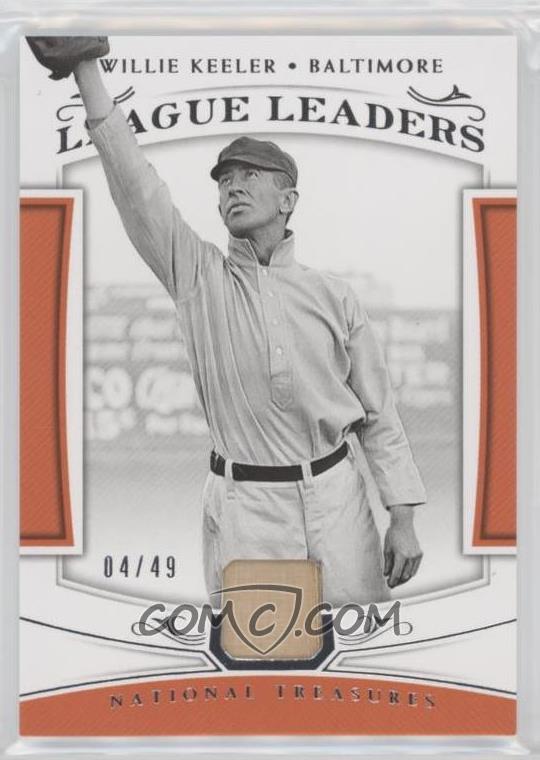
I picked up this Keeler relic for my collection after reading this book.

Get ready for three more of these posts! All that reading means a lot of writing! See you in 12 hours...