Chaos and Kanji is the blog where I write about my adventures through Japan!

Want Lists are located here. NPB Baseball Want List is located here.
Showing posts with label bromide. Show all posts

Thursday, April 8, 2021

Breaking Bad Bromides (No, Not "Breaking Bad" Bromides)

I love coming across new vintage Japanese cards. It's definitely not easy! Many of the menko and bromide cards in my collection came from US collectors helping me out, so what's left are unknown cards and rare finds. These blank-backed bromides were pretty cheap, but they did come at a price.

I don't know exactly where they were stored, but at least one of them smells like death. Like, seriously rank, God-awful stench. I left them sitting out for several weeks, but even so, after being in a sleeve or box for a while, the smell returns. I might need to leave them out in the sun for a few hours. Thankfully, they're all blank-backed so I can leave them face-down to avoid too much damage. On to the cards.

1950 Marutoku Large Black & White Third Prize Bromide - JBR 9a - Chusuke Kizuka. He's throwing so hard his feet left the ground.
Probably 1950 B&W Type 2 3rd Prize - JBR 2a. Shigeya Iijima. The fans look almost fake, like the Beatles Sgt. Pepper's Lonely Hearts Club Band album cover.
1950 Game Bromides Premiums - JBR 87a -  Akiharu Tezuka. This is one of three cards from this set I got. I put this one in my type collection.
1950 Game Bromides Premiums - JBR 87a - Tetsuharu Kawakami. Seeing a bit of the dugout made this a pretty cool card. This set has at least a few great photos.
1950 Game Bromides Premiums - JBR 87a - Takashi Kouchi. Here's another card from the Game set, this time showing some action on the basepaths. Kouchi is the runner, facing the camera. I think the umpire is levitating. And there are some spectators off in the background!
Black and White Small Text Bromides - JBR 124 - Hiroshi Nakao. This fairly standard card also went into my type collection.
Unknown card. Hiroshi Hagiwara. None of Hagiwara's cards match this description. So I have no clue which set it's from.
Unknown card and player. I love the image, but I don't know where it comes from. This card has a slightly glossier top, but it may be from some form of glue or something added by the collector. This has those odd printing/cutting crosshairs, which means it most likely was cut from a larger sheet at a shop or at home.
Probably 1950 B&W Type 3 3rd Prize Premiums (JBR 7a) - Tetsuharu Kawakami. Sadly, this card has some paper loss, but it still has a great image of the stadium in the background. And Kawakami is a legend.
1950 Color with Handwriting Bromide - JBR 89a - Shigeo Ueno. Another card with an interesting background, this one also is colorized! And it has an interesting stylized handwritten-style font. This card also made it to the type collection.

That's all for today! My favorite is probably the Kawakami with the scoreboard in the background. I'm a sucker for scoreboard shots. What's your favorite? Until next time..

Friday, February 19, 2021

It's A Big One! 1958 Fujiya Signature Premium with Printed Name

I love oddball cards. It's not because they're rare - sometimes they are. It's not because they're valuable - usually they aren't. It's because they're different. Some have airbrushed logos, others have logos or ads for cereal, soda, cars, hotels, or tobacco companies. And many come in different shapes and sizes.

Japan went through a card boom of sorts in the 1950s and early 1960s. While there was no set issued similar to what Bowman and Topps were doing, many companies issued game cards, "bromide" photo cards, or cards to be inserted into gum or other food products. I guess you could say it was similar to the card situation in the US in the 1900s through the 1920s.

Some of those issues came with larger premium prize cards. Most used the same design as regular cards, just in a larger size, but because they were prizes, they are much more difficult to find.

This card is an example of one of those premiums. Fujiya Caramel issued a small-size card set in 1958 along with several different premium large-sized sets. This is JF 24b, which has the team and player name printed at the bottom along with a facsimile signature. The backs are blank. Measuring about 5" x 7-1/2, this was definitely not found inside individual packs of candy. While I have no idea exactly how they were distributed, my guess is candy packs had regular cards inside or accompanying them, with winning cards or tickets randomly inserted, to be redeemed at the shops. A color set of premium cards is known to have been distributed in envelopes, so these might have been similarly packaged.

If you're wondering, the player is Motoshi Fujita, who played his entire career with the Yomiuri Giants. This would have been issued just after his ROY-winning rookie year, and during his first of two consecutive MVP seasons. Fujita would go on to manage the Giants for two stints totalling seven years in the 1980s to early 1990s. He won two Japan Series titles as a player and two as a manager, posting a nice 2.20 ERA on the mound.

Tuesday, January 5, 2021

1931 Yakyukai Magazine Bromides

 Say hello to the oldest Japanese card in my collection.

In fact, it doesn't get much older than this. Baseball's first professional teams formed in the 1920s, though the first real professional team (which would become the Yomiuri Giants) wouldn't form until 1934. Before that, most baseball was played by high school and college students. The Koshien high school baseball tournament started in 1915, with the spring version starting in 1924. The Tokyo Big6 Baseball League (college) was established in 1925, though college baseball was big for more than 20 years prior.

The first identified bromides in Engel's guide come from 1930, with all pre-war sets consisting of college players or US players from the Japan tours. It's definitely possible that cards were issued before 1930; in fact, I'm pretty sure they have been, but just haven't been cataloged yet. 

And that puts us with this card here:

The card above is identified as JBR 71: 1931 Yakyukai Magazine Sepia Bromides. Cards were included in the February 1932 issue of the magazine inside an envelope, and came blank-backed. The bottom text has the school name, player's surname, and position, from left to right. The card measures 3-3/8" by 5-3/8". Three cards were in the set. The card I have above is Kiyokazu Igawa, from Keio University. The remaining players are Osamu Mihara from Waseda, and Takeo Tabe from Meiji.

Yakyukai Magazine was issued for a very long time - from late 1911 through October 1959, it appears. Only two sets of bromides are listed in the Engel guide from the magazine, however: this one, and one for the January 1934 issue. The image above is the February 1932 cover. I'm not sure why Engel calls this a 1931 card, though while the cover date is February 1932, the magazine was possibly on shelves just before or on New Years.

Finding information on Igawa isn't easy. It appears he might have participated in the Koshien Tournament in the 1920s, and more famously, I think he was partly involved in what translates as the "Apple Incident" on October 22, 1933. While it seems that rivalry has caused problems for a long time, this particular event, involving the throwing of trash, including an apple core, was the impetus for creating specific cheering sections for fans.

To this day, sporting events have "cheering" sections where only that team's fans can enter; for smaller matches such as independent leagues that just means sit on your team's side, while NPB stadium rules basically prohibit entering another team's fan area (if you're wearing a Giants jersey, you aren't allowed in the Tigers fan area, and vice versa), and these fan areas can be fairly well "fenced in" to prohibit infiltrating enemy lines (and keep people from sneaking into more expensive seats). 

Odd note I discovered while preparing this post: the Japanese version of Wikipedia has a page explaining what a strike is in baseball. The page's photo shows Barry Bonds from behind home plate as an umpire calls a strike.

Tuesday, April 14, 2020

Uncatalogued/Unknown: Bromides

This post will show all of the Japanese bromide cards I have which I can not identify. This is intended to be a permanent post, updated as cards are added or subtracted.

Unless noted/displayed, all cards are single-sided. Players on bromides are much more difficult to identify than menkos, mainly due to a lack of text on several. And identifying the actual bromide sets are very difficult, as well. It's very likely that several of these have been identified already, but I was unable to match them to a particular set. As always, any help is welcome.
Card size: 2-21/32"H x 1-3/8"W. As you can tell from the scan, the image quality is very low; this might have been printed by a newspapaper! The card stock is actually thick paper with a glossy finish. There is no text anywhere on the card. The player is from the Hanshin Tigers, but I can't identify anything else.
 Card size: 3"H x 1-13/16"W. This bromide has a borderless black and white photo and is a little larger than tobacco menko-sized. The player's name (Kawai-player) and team name in parentheses is at the bottom in a somewhat handwritten style font. The player here is Yasuhiko Kawai, who played with the Dragons 1952-1958. This card is similar to JBR 16: 1956 Marumatsu Large B&W, in a borderless, smaller format; given the description for Kawai's card in the set, the photo might be the same.
 Card size: 3-1/32"H x 1-7/8"W. This card has a similar style to the three below, but is printed on a glossy stock that's slightly thinner. The player's name is somewhat larger than the team name in parentheses. This card could very well belong to JBR 29: 1956 Tobacco Menko Sized. The player is Toshikazu Kodama for the Dragons (1951-56); his family name is in the right text column, with the team name on the left.
 Card size: 2-16/16"H x 2"W. This card has a thicker paper stock with a slightly glossy front. The player is Kiyoshi Doi for the Taiyo Whales (1956-68). This black and white card is similar to JBR 18: 1957 Color Tobacco Menko Sized; no Whales are known for the set in an incomplete checklist. It also could come from JBR 29; Doi is listed in the checklist but "in catching gear".
 Card size: 3"H x 2"W. This card is printed on thicker paper stock with a slightly glossy front. The player's name and position are in the left column, with the team name in parentheses on the right. This card shows Hiroshi Ohshita with the Nishitetsu Lions (1952-59).
 Card size: 2-15/16"H x 1-29/32"W. Card stock is thicker paper with a slightly glossy front. The player's name and position are on the left, with the full team name on the right. This is Motoshi Fujita, pitcher for the Yomiuri Giants (1957-64).
 Card size: 4-3/16"H x 2-3/4"W. This is a slightly larger bromide, with the player's name, followed by the team name in parentheses in a single column. This card features Toru Mori while he was with the Taiyo Whales (1962-65).
 Card size: Approx. 5-1/8"H x 3-7/16"W. This card has a white back and no text anywhere. The player is a Yomiuri Giants infielder, based on the photo.
 Card size: 4-3/4"H x 2-15/16"W. The card has a colorized photo with a green-tinted background. The team name is in the right column, with the player's name and position in the left. This is Makoto Kozuru, infielder with the Dragons. The card says "Dragons" in katakana for the team name, but his jersey says "Chubu Nippon" (Central Japan), which was used 1946-47. The team officially became the Dragons in 1947, and Kozuru moved to the Flyers in 1948, so this card was most likely issued 1947 or early 1948.
 Card size: Approx. 5-1/2"H x 3-1/2"W. A colorized photo with a yellowish border; the bottom of the card has typed text with the team name, player name, and position. Translation: Nagoya Dragons / Tsubouchi Outfielder. Michinori Tsubouchi played with the Dragons 1949-1951. The uniform he is wearing was used 1950-51, so this card must have been issued aroud that time. Just as a side note, Tsubouchi's hat has the interlocking NC, for Nagoya Chunichi. Also, his jersey number appears on his pants just to the left and below his belt.
 Card size: 4-1/16"H x 3-1/8"W. Team name is on the first line, with the player's last name and position below it in a larger font. Michio Nishizawa, first baseman for the Dragons (most likely 1949-1958). Given the font, this is very similar to JBR 41: 1950 Yamakatsu B&W. This might be a premium card issued with that or another Yamakatsu set issued around that time.
 Card size: 3"H x 2-1/4"W. These six cards all appear to be from the same set. There is no text; the card fronts and backs are the same color card stock. The printing quality is pretty low. I haven't identified any of the players in this set. The top three cards feature Tigers in their home uniforms. The first card in the second row shows another Tigers player in a dark uniform, which apparently was used in 1948-49. The lower-center card features a Robins player in a grey uniform with stripes on either side of the buttons; this uniform was used in 1949. The hat also appears to have an R similar to the style they used that year; they would switch to a shield from 1950. Finally, the Hawks player on the bottom-right is wearing a jersey which was worn from 1949-50. Therefore, this set was most likely issued in 1949 or 1950.
 Card size: 3-1/8"H x 2-3/8"W. This group of 10 cards most likely come from the same manufacturer, but possibly three or more different issues. The sizes aren't exact, and cards would have been hand-cut from full-size sheets. They are printed on thicker paper stock/photo stock. A few cards have black text, team name is smaller to the upper left and includes position; a few have white text, team name is beneath the player name in parentheses; and a few have no text at all. All text is vertical. Card information (left to right, top to bottom):

  1. Katsumi Shiraishi, Yomiuri Giants. Black text 1948-49.
  2. Noboru Aota, Yomiuri Giants. No text. 1948-52. Jersey possibly dates to 1951.
  3. Unknown, appears to be Hanshin Tigers from the cap, 1947-51 jersey. No text.
  4. Takehiko Bessho, Nankai Hawks. White text. 1946-48, but the uniform dates this 1947-48.
  5. Kaoru Betto, Hanshin Tigers. Black text. Jersey dates 1947-51.
  6. Same card as #4
  7. Shigeru Chiba, Yomiuri Giants. Black text. 1947-50 jersey.
  8. Tetsuharu Kawakami, Yomiuri Giants. White text. Based on the stirrups (image quality isn't great) this might be the 1951-52 jersey.
  9. Probably Tadayoshi Kajioka, Hanshin Tigers. No text. Appears to be 1951-53 jersey.
  10. Hiromutsu Tsukamoto, Hankyu Braves. No text. 1948-49.
It's possible these are a variation of JBR 75: 1948-49 Sepia w/Vertical Name & Team. Several of the image descriptions appear to match up, though the size does not. A few of the jerseys seem to match around 1951, but the original image quality is very poor so I could be wrong in my assessment.

Wednesday, February 20, 2019

Unknown Bromides

A couple weeks ago, I took an overnight trip to Nagoya. I got a late start, putting me in town around 1 p.m. But that was fine, since I was spending that whole day just going from card shop to card shop. My first stop was CAPS, a former Mint shop that will be closing down in the next few months. They're slowly clearing out a lot of their singles, though apparently they plan to keep some sort of online business going.

I picked up a lot of good cards there, but most importantly and confusing were these bromides. I can't identify them. I can't tell you much about them, but if you know anything to add to them, let me know!

Note: the measurements are being made with my iPhone app, so they might not be very accurate.
 This card is about 9 cm wide and 13 cm long. There are no markings or borders at all, and the back is white. I have no clue about the player, though it is obviously a Yomiuri Giants player.
 This is Michio Nishizawa, who is pictured with the Dragons. He played with them his entire career, though I'm guessing this card was issued sometime from 1947-1958 (his final season). Nishizawa started as a pitcher, even throwing a no-hitter, but eventually left the mound and developed into a pretty good hitter. He went on to manage the team for a few years, compiling an over-.500 winning percentage. He's in the Japanese Baseball Hall of Fame and his number, 15, has been retired by Chunichi. This card has a white or off-white back. You can see the border and the horizontal, white text on the front. It measures about 8 cm by 10 cm.
 Makoto Kozuru is another Dragons player who is now in the Hall of Fame. He played with the Dragons from 1942-1943, and 1946-1947. Like Nishizawa, this card has a white back. The image is colorized, with a green background, red shoes, and yellow socks. I believe it's about 7 cm by 11 or 12 cm.
Finally, this colorized card has a yellow border, though it doesn't show up well in my scan. The text at the bottom looks more like type, where the other cards have text that looks handwritten. It has a tan back, and is printed on thinner stock than the others. It measures about 9 cm by 14 cm. The player featured is Michinori Tsubouchi, another Dragons player. He was with the team from 1949-1951 as a player, though also managed the team through 1954, and again from 1965-1967. He, too, is in the Hall of Fame.

I wasn't able to identify the cards looking through Engel's guide, but I might have missed something. Regardless, they're neat cards, and given their sizes, are probably prize cards from various sets. And at least three of the four are hall of famers!

And I got one more big bromide, but it's so big I couldn't scan it. That one has Shigeru Chiba, who is also in the Hall of Fame, so I'm at least four for five.

Until next time...

Tuesday, March 27, 2018

Sho Me What You've Got

There is no typo in my post's title. All of these cards feature that Fighters player you haven't heard of.

While Shohei Ohtani has been all over the sports pages, Sho Nakata has been all over my mailbox. Well, just in one package.

I got a bunch of random Nakata oversized cards in a lot from Yahoo Japan Auctions, mainly for the bromide. Here they are:
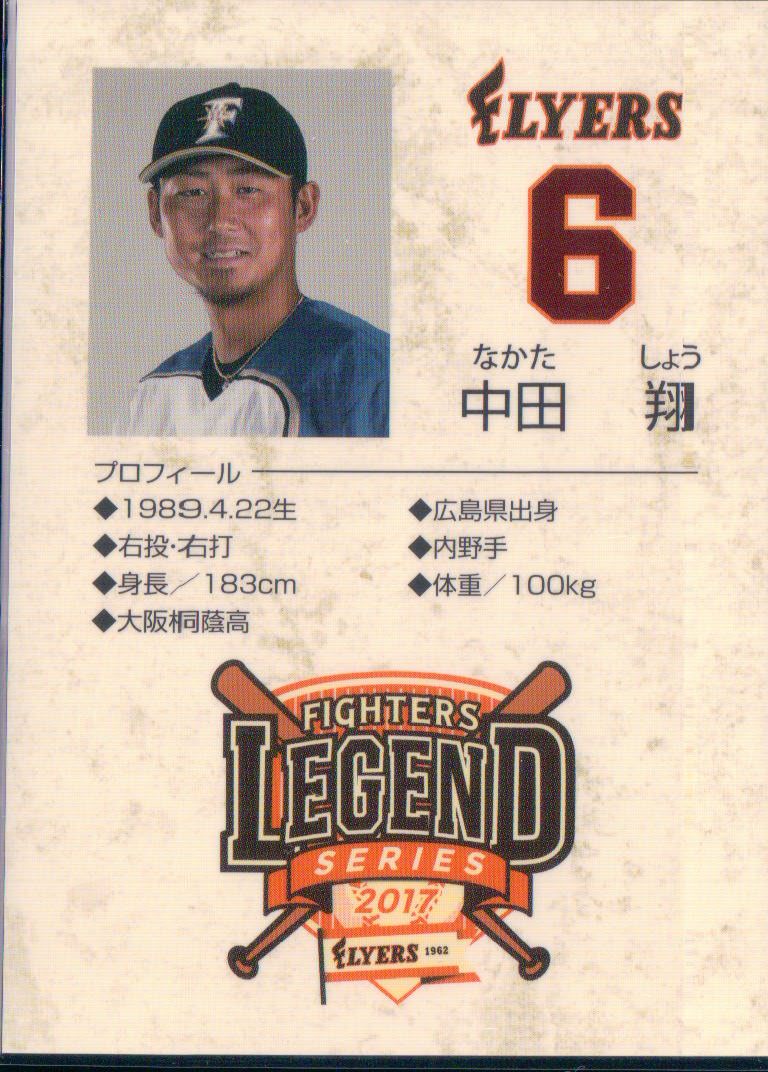
 It's always nice to get some English on a card to identify where it's from. The Fighters had a bunch of turn-back-the-clock events in 2017, which tehy called Legend Series. This card represents the Flyers era. I believe this is the same series where they also gave away replica retro jerseys. I love the retro menko-style design!
 I already have samples from this release. In 2011 the Fighters released a series of bromide-sized cards, and it was popular enough that I've seen singles at a few card shops around Japan. The card number is in the lower-right corner.
 There's also a foil signature version, obviously not paralleled as it has a different photo and the card number is different (SP.05 here).
My scanner doesn't like black and white images. Or perhaps it can't handle black and white images printed using color inks, as this probably was. Anyway, this is a Japan Post-issued postcard. Collaborations are big in Japan, and the postal service isn't afraid to capitalize on popular culture.

I'm happy to add these to my collection, especially the Legend Series bromide. Hopefully I'll find more of the Legend Series in my travels.

Until next time...

Thursday, January 11, 2018

Oddball Find: Idol Bromide PP Cards

 Sold like most bromides, these cards came in a pack (front and back shown above), individually packaged in light lavender colored envelopes. Each envelope originally would cost 20 yen (about 20 cents). "PP" is, I believe, some kind of plastic/coating - the cards are kind of shiny and some rare ones have hologram backgrounds. I've seen "PP" used on other sets as well, and they usually have that background for at least some of the cards.

There is no manufacturer listed. There are 30 cards in each full pack plus the one on the front.The cards below are sorted by "number" though at least one card number is shared. The subjects are all idol music stars. I could spend a few hours figuring out details, but I'm going to just go with "early 1990s" as the era these are from.
 Each card front has a "Power" number, which is always a four digit number with the last two digits "00". There's also a playing card symbol with a janken (rock-paper-scissors) symbol inside. This card is of Eriko Tamura.
 The backs are virtually identical for every card. The same six photos in colored boxes take up most of the space, with "IDOL BROMIDE" along the left edge. The bottom has a number which I'm using as the card number, followed by the name of the person on the front of the card. As you can see here, Takuya Kimura is a member of SMAP, a boy idol group.
 Yumiko Takahashi
 Rieko Miura of the girl group Coco.
 Alisa Mizuki (Arisa Mizuki).
 Tsuyoshi Kusanagi, also of SMAP. This is a good point to mention that there are actually a couple different backs - the design is exactly the same, but the dark-pink (fuchsia?) colored backs have six different photos from the yellow colored backs. And later on, you'll see a third style.
 Rie Miyazawa. You can see her on the back, but in a slightly different photo from the same event.
 Goro Inagaki, another SMAP member.
 Takuya Kimura of SMAP with another card. A cropped version of this photo appears on the back of the rare cards.
 from Hikaru Genji, a music group, this is Akira Akasaka. Note that he shares the same card number as Takuya Kimura. It's possible that there are about 60 cards in the set, with 30 yellow-back and 30 pink.-back. But I don't have enough evidence to even begin checking that.
 Hiromi Nagasaku from the group Ribbon (Ribon here). She's gone on to become a comedic actress.
 Riho Makise
 Alisa Mizuki again
 Masahiro Nakai, the oldest member of SMAP.
 Here's Riho Makise again.
 Hikaru Nishida has pretty good English skills, since she lived in LA for about 12 years.
 We have the full SMAP group with this last card of Shingo Katori.

Now on to the rare shinies. These are unnumbered and have a slightly different back design. But what sets them apart is the holographic foil backgrounds. Super cool! These are also pretty rare, though I don't know how many are in the set so I couldn't tell you how rare each card is. I will say that I got two out of the envelopes (that's 1:15 odds), plus I kept the one from the front of the display package.
 Here is SMAP all together.
 Hikaru Nishida returns with a peace symbol.
And one more Riho Makise for the road. This is the card which was on the front of my packaging. These days, "sample" cards are put in small plastic sleeves, which are then taped to the front, but this card was simply taped to the front of the package. So there's a tiny bit of residue from the tape, and from something else. I could probably clean it up a little bit if I tried.

And that's it! I had a decent number of duplicates, so if this set really has 60+ cards in it, good luck finishing it all. But the images found on the backs weren't duplicated on the fronts of most of my cards, meaning there must be several more cards out there. Perhaps (I'm doubtful) I'll come across a few more taba packs of these and we'll find out together!